Menu

Showing posts with label tobacconist certification. Show all posts

Tuesday, May 5, 2026

Everything Leads to This Moment


The history, tradition, and artistry behind every cigar are realized at the point of service, where the cigar meets its ultimate consumer. 

Every cigar represents years of cultivation, fermentation, aging, and craftsmanship.  Leaves are grown, harvested, cured, and blended with mastery and intention. Each cigar passes through hundreds of hands before being crafted into a finished product. 

That experience does not execute itself.

Even in the hands of an experienced smoker, the condition, presentation, and context in which a cigar is delivered will influence how it performs. Storage, rotation, humidity, handling, and knowledge are not secondary details. They are determining factors.

This is where the role of the tobacconist becomes essential.

Not only as a curator of inventory, but as the custodian of quality and the champion of standards. The tobacconist is responsible for ensuring that every cigar is preserved, represented, and delivered as intended.

The tobacconist does not exist solely to guide the novice. They exist to uphold the standard. They are the point at which the work of the industry is either upheld or compromised.

At that moment of service, everything that came before is either realized or forgotten. 

Tobacconist University is built by tobacconists, for tobacconists, from the ground up to operate at that exact moment, where the customer meets the product. It is not built for passive learning. It is built for execution at the point of service. It is a structured system designed to train, certify, and support professionals at the point where the industry becomes real.

Through a comprehensive curriculum, tiered certification pathways, and defined standards of knowledge, service, and accountability, Tobacconist University goes beyond passive learning and quiz-based certification.

It is not designed to test what someone can recall. It is designed to impart strong fundamentals and shape how a professional performs.

Tobacconist University teaches the foundation and fundamentals the right way, so that professionals can continue to learn from anywhere, while knowing what is right and what is not. Because once the foundation is built incorrectly, everything that follows becomes distorted.

Certification is tied to application, to conduct, and to representation at the point of service. Every certified tobacconist operates within a system that extends beyond the classroom, supported by real-world tools, resources, and infrastructure built for the trade.

This includes professional listings that identify qualified tobacconists to the public, The Tobacconist Handbook as a foundational reference for the industry and behind the counter, ongoing research and development through the R&D Lab, and scalable programs such as the CCST Maestro system, which allows certified professionals to train and certify others across the industry.

Together, these elements form a living system. One that supports not only individual knowledge, but the consistent execution of standards throughout the industry.

Because in the end, it all comes back to the moment where the cigar meets the customer, and everything that came before is either realized or lost.  That is why the standard matters.


Monday, March 23, 2026

What Is Tobacconist University?

For generations, the luxury tobacco industry has been sustained by knowledge.

Knowledge passed from cigar and pipe makers to protégés.

From master tobacconists to apprentices.

Shared across humidors, lounges, and retail counters.

Refined in fields, factories, and through experience.

Yet in an industry built on expertise, formal education has long been limited, fragmented, or nonexistent.

Tobacconist University was created to change that.

From the beginning, our mission has been clear:

Educate. Engage. Advance Culture.

Tobacconist University exists to elevate knowledge, professionalism, and credibility across the luxury tobacco industry.

Our goal is not simply to provide certifications.

Our goal is to strengthen the intellectual and cultural foundation of the industry itself.

Over the years, TU has developed the most comprehensive and free body of educational material ever assembled for luxury tobacco professionals and enthusiasts.

Our Campus includes:

• Tobacco College

• Accoutrements College

• Taste College

• Service College

• The industry's most comprehensive glossary of terms

• A continually expanding body of frequently asked questions and reference materials

Unlike most academic institutions, this curriculum is largely available to the public. It does not exist behind a paywall.

We believe knowledge strengthens the entire industry.

- Retailers benefit.

- Consumers benefit.

- Manufacturers benefit.

- The culture itself becomes stronger.

Through structured learning, standardized certification, and a global network of trained tobacconists, we are building something the industry has never had before:

A true academic and professional foundation for luxury tobacco.

Whether you are an enthusiast, a retailer, or an industry professional, Tobacconist University provides a clear path:

To learn.

To refine your craft.

To elevate your role in the industry.

This is more than education.

This is the advancement of a culture.


Tuesday, January 13, 2026

The Art of The Final Exam


What is a final exam?  At the very least, it is a comprehensive wrap-up at the end of a course, designed to test your knowledge and retention - not just the last chapter or a small section, like a quiz.  A final exam must cover and test the most important points of the curriculum, ensuring the graduate's knowledge is thorough and truly merits final certification.  It must be specific, comprehensive and thoughtfully crafted to ensure credibility in both the education and educated.  

Even when all of these requirements for a final exam are met, an important question remains: how many questions can a student get wrong and still pass?  What constitutes a passing grade even when the student gets things wrong?  Tobacconist University (TU) has always maintained a 90% standard for all exams, but even that high bar leaves room for improvement and imperfection.  

While we now count our certifications in the thousands, TU administered its first 400+ paper exams in face-to-face settings, where every question was discussed, challenged, and refined in real time.  We gathered direct feedback on the language of each question, observing how students interpreted specific words, phrasing and emphasis.

This process allowed us to see how meaning was perceived, misunderstood, or clarified.  We learned how to structure language more precisely, which words required emphasis, and how subtle wording changes affected comprehension.  That feedback enabled us to re-engineer and carefully craft our exams to serve the broadest possible spectrum of students and English speakers - no small task in a curriculum that necessarily includes many Spanish terms.  

That same level of care also applies to the answer choices themselves - both correct and incorrect - for every question on the final exam.  The incorrect answers are just as important as the correct ones, believe it or not!  You don't want to trick people nor do you want to make things too easy.  Typically, a well-designed multiple-choice question includes one clearly implausible "throwaway" option to help orient the test -taker.  The real challenge lies in crafting the remaining incorrect answers so they are plausible, educational and constructive - often referencing material the student already knows, guiding them toward the correct answer, or reinforcing knowledge that may apply elsewhere in the exam.

It is a complicated, intricate, and imperfect process.  And in many ways, a little artistic as well.  We go through all of this to ensure that graduates are given a fair opportunity to demonstrate mastery of the fundamentals and facts required to earn their certification.  While no exam can be perfect, the effort behind it must be extraordinary to ensure the certificate itself carries genuine merit and credibility.  

Rest assured, there is no equal to the time and effort we have invested in our curriculum and final exams.  The Tobacconist University Certification is unparalleled in both quality and content.  For those who are serious about education and professionalism, there is no other option.

FUN FACTS

- 50% of TU students pass their final exam on the first attempt.

- 90% pass by the second attempt.  

- The remaining 10% receive additional, personalized support, which may include a final exam review curriculum or the opportunity to take the test with a Certified Tobacconist online and available to help.  

- TU Final Exams have been 100% online since 2018. 

- Each Final Exam Question Database contains 20% more questions than appear on any individual exam, allowing for rotation so that no two exams are exactly alike.  

- There are certain fundamental questions which must be answered correctly from each of our Colleges, FAQs, and Glossary entries, and they must be distributed proportionally and aligned with our educational objectives.  For example, the Certified Retail Tobacconist (CRT) degree includes approximately 15% of its final exam questions on non-cigar tobaccos and pipes*, while the Certified Cigar Sommelier Tobacconist (CCST) degree has none.

* Approximately 95% of the luxury tobacco industry is cigar-focused, whether measured by revenue or shelf space. As a result, many of our Certified Retail Tobacconists (CRT) tell us we include too much pipe and non-cigar related exam questions and content, while pipe specialists tell us we don't have enough.  It is a struggle to balance it all, but we believe that a deep and working knowledge about pipe tobaccos broadens perspective and deepens appreciation - even for cigar specialists. 

- Over the years we have seen many imitators, posers, and influencers attempt to produce so-called "educational" content.  Without exception, every "masterclass", "school", or "academy" we have evaluated delivered, at best, mediocre assessments - often featuring questions that bear little or no relationship to the material being taught.  This level of negligence in educational design is not merely disappointing; it is professionally indefensible and reprehensible.

- Creating comprehensive and substantive Final Exam Questions is one of the hardest challenges faced by Tobacconist University.

- Certified Consumer Tobacconist (CCT) and Certified Cigar Sommelier Tobacconist (CCST) final exams are 50 True/False and Multiple-Choice Questions - all other degrees are 100 questions.

In our thirty years of service, only a handful of students have every abandoned the certification process.  The single greatest obstacle to passing the final exam is not a lack of intelligence or effort - it is not knowing what one does not know.  Many people arrive with erroneous beliefs or incorrect knowledge ingrained in them, often acquired from the internet or a well-meaning but misinformed friend, and they don't reconcile or transcend that when studying.

And that is precisely why we exist: to teach proper fundamentals and transform information into professional-grade knowledge - from the first pages of our academic curriculum to the last question on the final exam.    


Thursday, November 21, 2019

Certification FAQ


Everyday we get emails and phone calls with questions about our certification programs.  Here is a helpful table to help you compare, contrast and understand the differences between our programs.  You can always email or call if you have any other questions.

You can also visit the GET CERTIFIED section of our website to get all the details.

Tuesday, December 9, 2014

Why Get Certified? Building A Culture Of Professionalism


What is certification?  Why should you be certified?  And how do you become certified?  These are the questions TU President and Founder Jorge L. Armenteros, CMT answers in this video interview.  

Whether they choose to get certified to strengthen their business, brand, and professionalism or to take advantage of the promotional value provided by TU, over 1200 tobacconists have already answered these questions for themselves.  But, every day legislators, special interest groups, bureaucrats and the nanny state try to usurp your professional and individual rights, disparage the tobacconist profession, and enact new taxes.  TU exists to educate consumers, professionals, legislators, and the entire world about premium and luxury tobacco products and their history.  Without education, there will be no salvation!

Of course, if you don't believe in a code of ethics and standards, professionalism, or excellence, then certification is not for you...

"The luxury and premium tobacco industry will not exist without the retail tobacconist"

Wednesday, February 6, 2013

Top 5 Reasons To Be Certified


1) Credibility Matters- Enhance your professional credibility by becoming Certified by TU. Immersing yourself in our extensive academic curriculum will help to further establish your professional credentials. By completing the Steps to Certification, CRT’s adhere to our high expectations in regards to product knowledge and customer service thus become knowledgeable, trustworthy in the eyes of consumers and peers.

2) Personal Satisfaction/Self-Esteem- Becoming a CRT will define and shape yourself beyond your job description. You will achieve a deep sense of personal satisfaction as well as validate your luxury tobacco experience.

3) Make your Certification work for you- Promote yourself. Wear your certified lapel pin and display your diploma and other certified accoutrements. Let your certification set you apart from other retailers. TU Certification also works as a free training vehicle for your employees. Customers view certification as a guarantee they will receive a high level of quality service, it demonstrates a commitment to our industry.

4) Improved Skills and Knowledge- Develop a well rounded educational experience while studying the four Colleges that comprise Tobacconist University: Tobacco, Accoutrements, Taste, and Service College.

5) Stay Tuned- Only certified retailers can profit from selling The Tobacconist Handbook or administering the final exam to Apprentices. We also have many exciting  projects in the works which only Certified Tobacconists will benefit from.

Tuesday, July 14, 2009

Cigar Anatomy: Final Exam Review


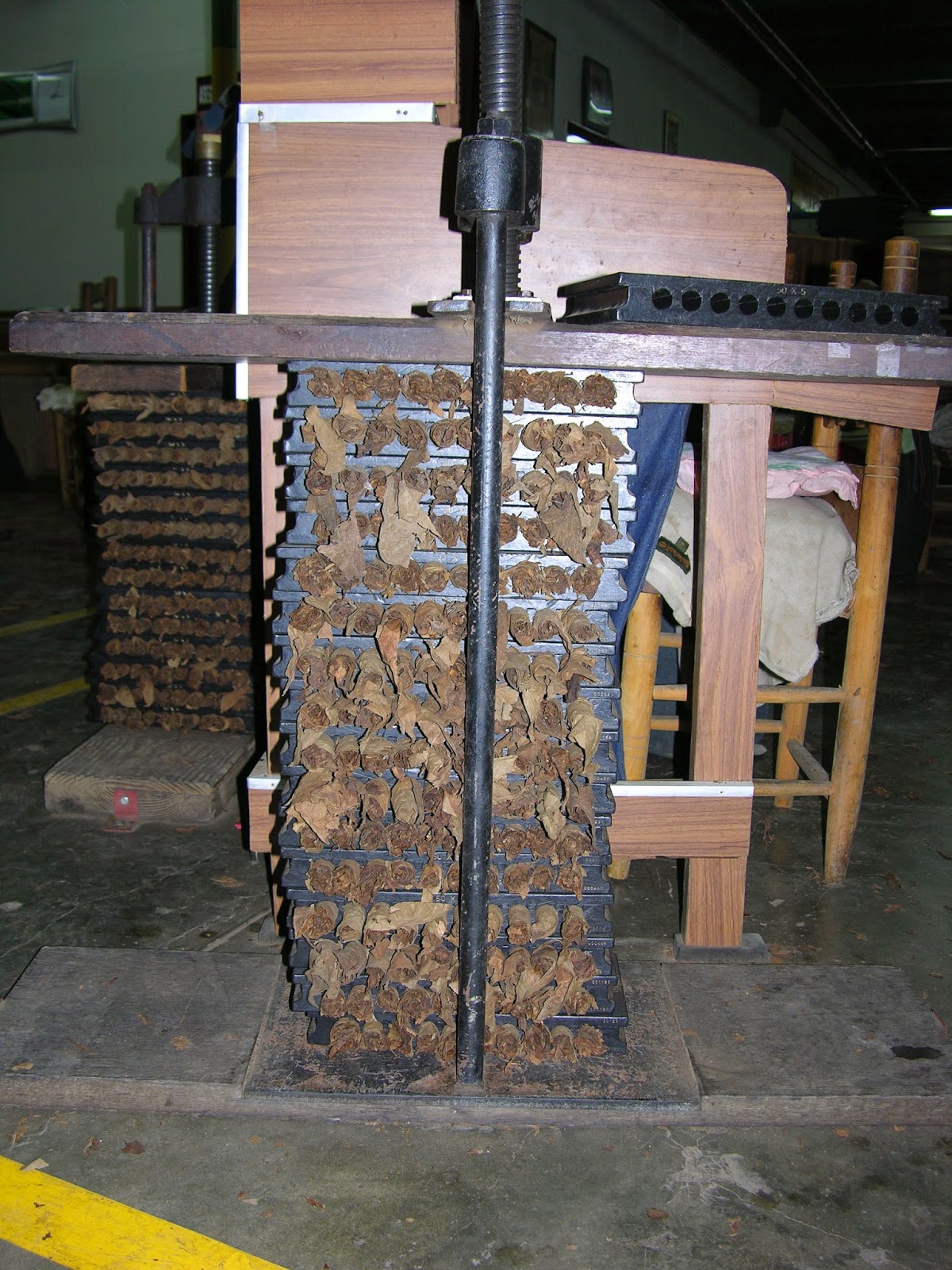
Premium cigars are composed of long filler, binder, and a wrapper. They are made exclusively by hand, although the bunch (binder+fillers) can be created using a Lieberman machine which assists the roller. In general, bunchers place 3 to 5 filler leaves* together and wrap them with a binder leaf, then place them in a mold and press.  The bunched cigars are rotated in the mold several times, about every 30 to 45 minutes, in order to create an even compression without a seam.  After the bunch is removed from the mold and press the wrapper leaf will be applied.  Wrapper leaves have their entire stem removed and each half of the leaf will be used on separate cigars.  These wrapper leaf halves are mirror images of each other so one will be applied right-to-left and the other left-to-right.  It is important to note that wrapper leaves are prized for their elasticity, tensile strength, consistent color and texture.

*Important Note: filler leaves have only half of their stem removed.  The half closest to the tip of the leaf is the thinnest part and it will remain; the thicker bottom half will be discarded.